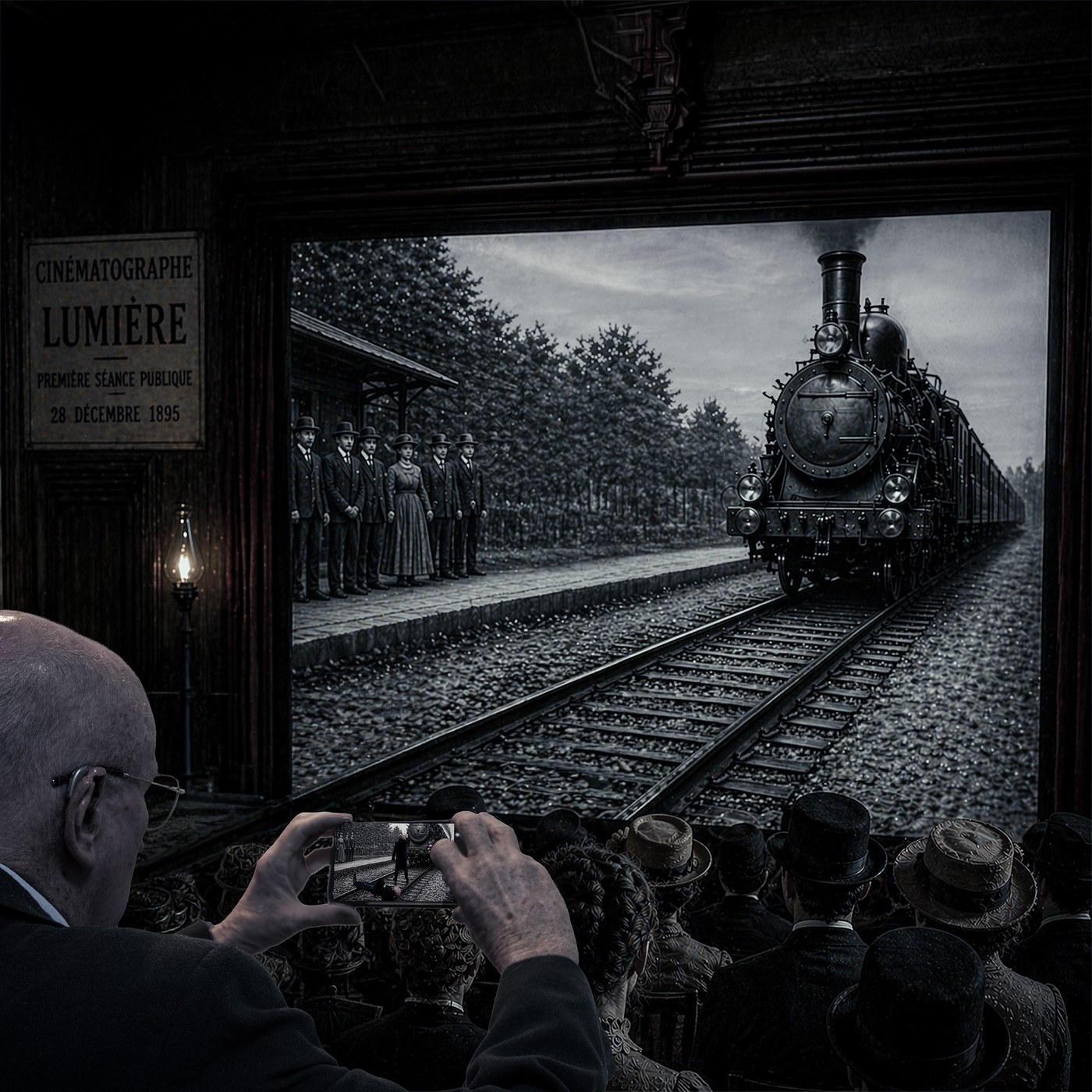
Inside a dimly lit, wood-paneled cinema, an audience dressed in late 19th-century attire sits facing a large screen displaying the iconic arrival of a steam locomotive at a station. A sign to the left announces the Lumière brothers’ historic 1895 screening. In the foreground, an elderly man—clearly out of place in time—raises a modern smartphone, photographing the projected scene. His presence introduces a striking temporal dissonance: while the audience witnesses one of cinema’s earliest moments, he captures it using contemporary technology, creating a layered image where past and present coexist within a single frame
Behind the image
The sign beside the screen reads December 28, 1895. That evening, the Lumière brothers held their first public screening for a paying audience in Paris. The film of the train at La Ciotat wasn't on the program that night, but I put it in my version anyway. The audience watches a train pull into the station and come to a stop. Passengers get off, and others get on.
In my imagination, the Lumière brothers filmed the train arriving twice. They showed the second take to the audience. To see the first, you have to come a little closer to my picture and look at the small screen on my camera.
There, a man is lying on the tracks. The stationmaster stands between him and the train, trying to stop it. But this is a still photograph, and this is where it stops.
Did the stationmaster manage to save the man or not? We'll probably never know.