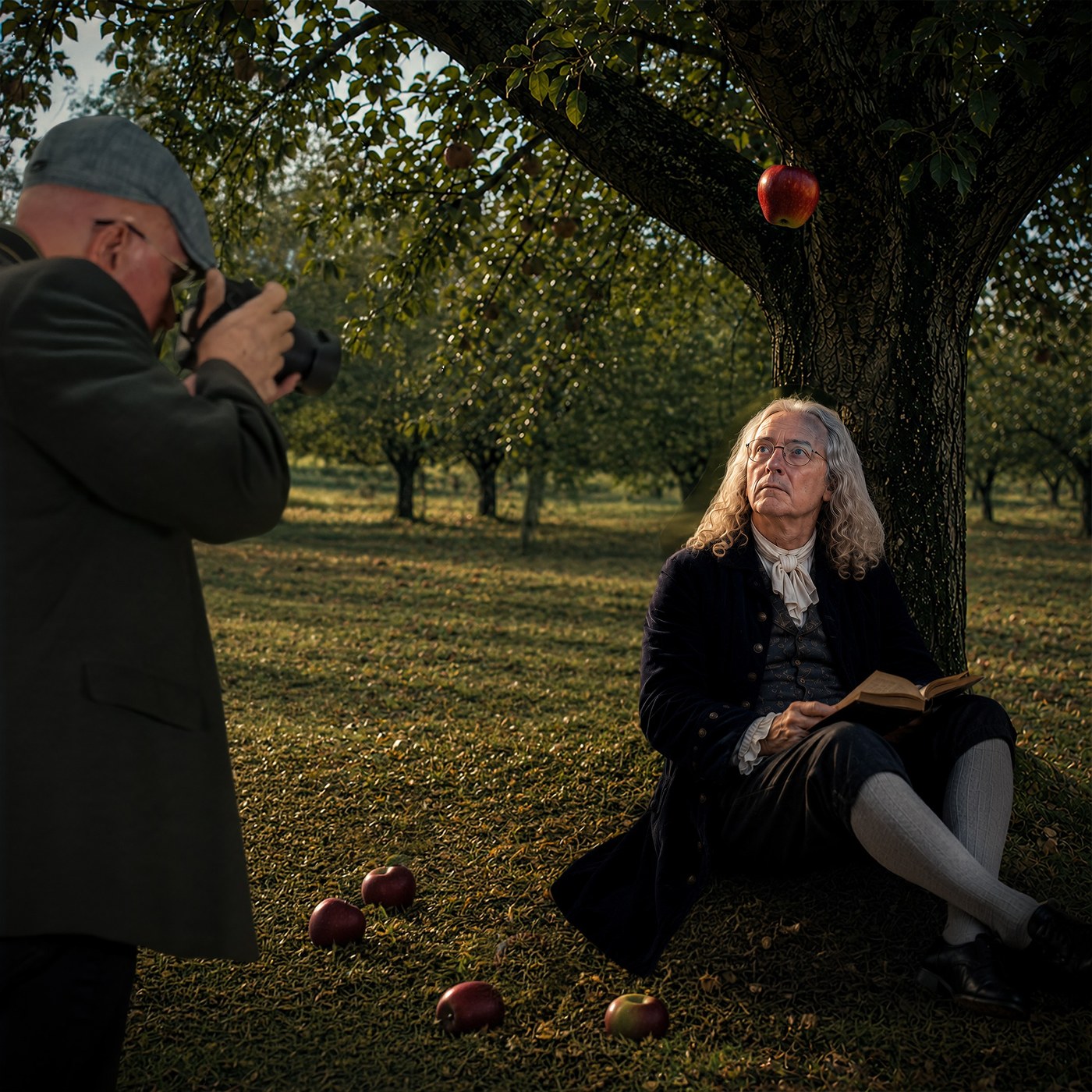
In a tranquil orchard bathed in soft evening light, an elderly photographer stands at the edge of the frame, camera raised, documenting an extraordinary encounter across time. Beneath a sprawling apple tree sits Sir Isaac Newton, dressed in period clothing and holding an open book, his gaze lifted toward a single red apple hanging above him. Several fallen apples scatter the grass around him, while the modern photographer—part observer, part intruder—appears to capture the very instant before revelation strikes. The composition juxtaposes centuries through costume, posture, and technology, blending pastoral serenity with subtle temporal dissonance. The warm cinematic lighting and carefully balanced framing create the feeling of a historical memory interrupted by contemporary consciousness.
Behind the image
Woolsthorpe Manor, Lincolnshire, England, around 1666
Everyone knows the story of Newton’s apple. When Newton told it to his friend William Stukeley, he said that seeing the apple fall made him wonder why it fell straight down. He said nothing about being hit on the head. In my version, he gets hit five times.
In the picture, Newton is sitting under an apple tree with an open book in his lap. Four apples are already lying on the grass. They’ve all hit him on the head, but it’s only when the fifth one lands that he says, “Wait, there’s something here.” And I, the time traveler with the camera, arrive just in time to catch the moment when Newton, as I like to put it, invented gravity.
A quarter of a millennium later, Einstein came along and said, more or less: You don’t need a force. Just curve space and time a little. It made no difference to the apple, by the way. Or to Newton. He still got hit on the head.