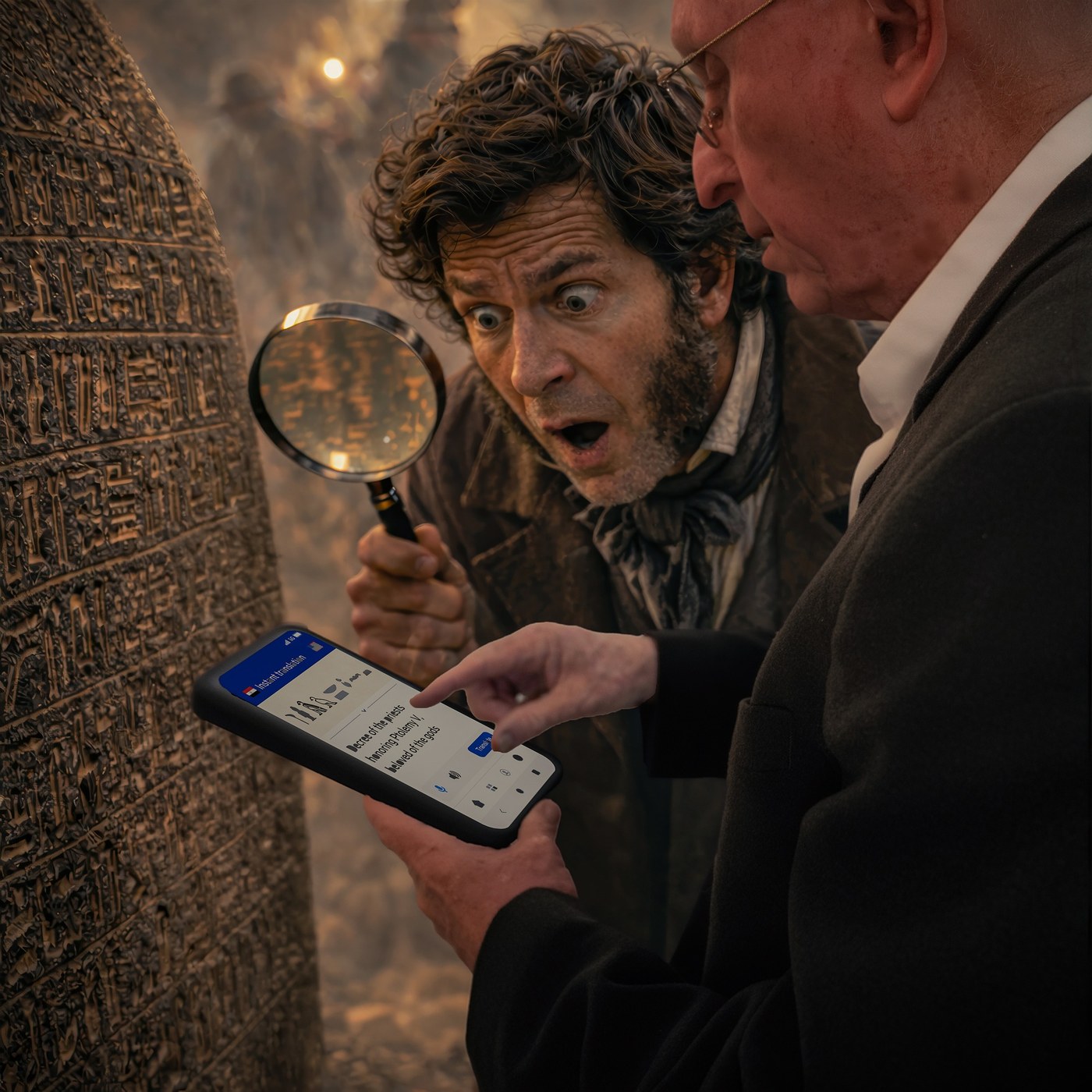
At the heart of an archaeological setting stands the Rosetta Stone, its trilingual inscriptions—hieroglyphic, demotic, and Greek—etched into its ancient surface. A visibly astonished Jean-François Champollion leans forward, magnifying glass in hand, his face frozen in a moment of intellectual revelation. His expression captures the exact historical breakthrough: the realization that hieroglyphs are not merely symbolic but phonetic. Beside him stands the time-traveling protagonist—an elderly, bald man with glasses—calmly holding a modern smartphone displaying a translation interface. He points toward the decoded text, as if guiding Champollion through the very discovery that, in reality, took years of painstaking scholarship. The lighting is warm and charged with historical gravity, while blurred figures in the background evoke the scholarly and archaeological world of early 19th-century Egyptology. The scene crystallizes a single impossible moment: the instant in 1822 when the silent language of ancient Egypt began to speak again.
Behind the image
1822: Champollion deciphers the hieroglyphs
Champollion bends over the Rosetta Stone with a magnifying glass. I’m standing beside him. This time, I left my Nikon at home.
“Do you see that oval frame?” I ask. “It might be a king’s name. If the same name appears in Greek, you’ve got somewhere to start.”
He brings the magnifying glass closer again. “Wait, I know a quicker way.” I pull out my phone, open an app that translates hieroglyphs, and point the camera at the stone. The name Ptolemy appears on the screen. Beneath it, in a few words: The king lowered taxes and gave grain to the temples. The priests decreed that ceremonies should be held in his honor.
I hand him the phone, rather pleased with myself. Champollion looks at the screen and mutters, « Mais qu’est-ce que c’est que ça ? »
“But what on earth is that?” I barely understand French, but I understood that.
He hands me back the phone and points at the stone. “Very nice,” he says. “Now show me where it says Ptolemy.”