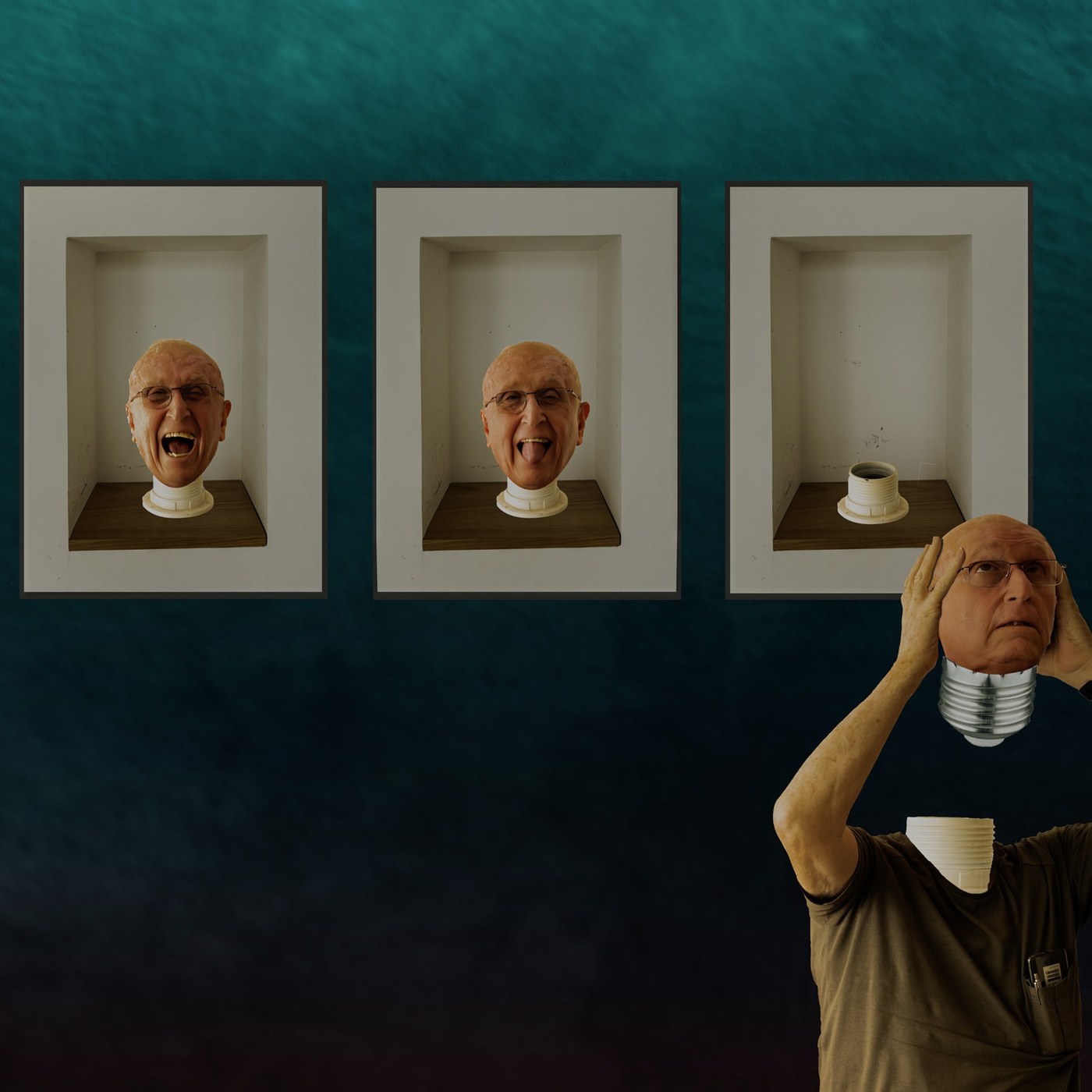
In the image titled "A Kit for Every Mood," the protagonist’s head is depicted in various stages of emotion and expression, placed inside three display niches on the wall. Each niche presents the head in different emotional states, almost as if they were objects for selection or purchase. The first head displays an intense, almost primal scream, its mouth wide open in a powerful outburst. The second head shows a playful expression, with the protagonist sticking out his tongue, creating a humorous and lighthearted tone. The third niche is empty, with only a base remaining, indicating the absence of the head.
A Kit for Every Mood
Archival pigment print · 2023
Archival prints from $800 · editions of 7, 3 and 1
◆ Signed Certificate of Authenticity in every package
Reading the work
The central theme in “A Kit for Every Mood” is emotional adaptability. The three heads, each representing different emotions, suggest that emotions can be chosen or discarded at will. This theme reflects the way individuals often change their emotional “masks” to fit different situations, whether consciously or unconsciously. The playful nature of the image, with its humorous depiction of the protagonist swapping heads, introduces the idea that emotional expression is often a performance, something one can control or manipulate. Another key theme is identity and self-expression. By presenting the protagonist’s head in multiple emotional states, the image explores the idea that identity is not fixed but fluid, shaped by the emotions we choose to display at any given moment. The empty niche where the third head should be adds to this theme, suggesting that sometimes emotions are absent or suppressed, leaving only a void where expression once was. The fact that the protagonist is holding his head in his hands emphasizes the idea that we have control over how we present ourselves to the world. There is also an element of absurdity and humor in the image, underscored by the exaggerated facial expressions and the idea of physically swapping heads. This absurdity encourages the viewer to reflect on the sometimes arbitrary nature of emotional expression and how we, as humans, often struggle to choose the “right” emotion for different situations. The image prompts viewers to consider the performative aspect of emotions and the extent to which our outward expressions may not always align with our internal states. Finally, the image touches on the theme of emotional complexity and compartmentalization. The protagonist’s emotions are literally compartmentalized into neat niches, reinforcing the idea that emotions are often categorized, managed, and sometimes suppressed in order to function in various aspects of life. The protagonist’s detachment from his own head further emphasizes the concept of emotional distance, suggesting that at times we treat our emotions as separate from ourselves, something to be controlled or even commodified.