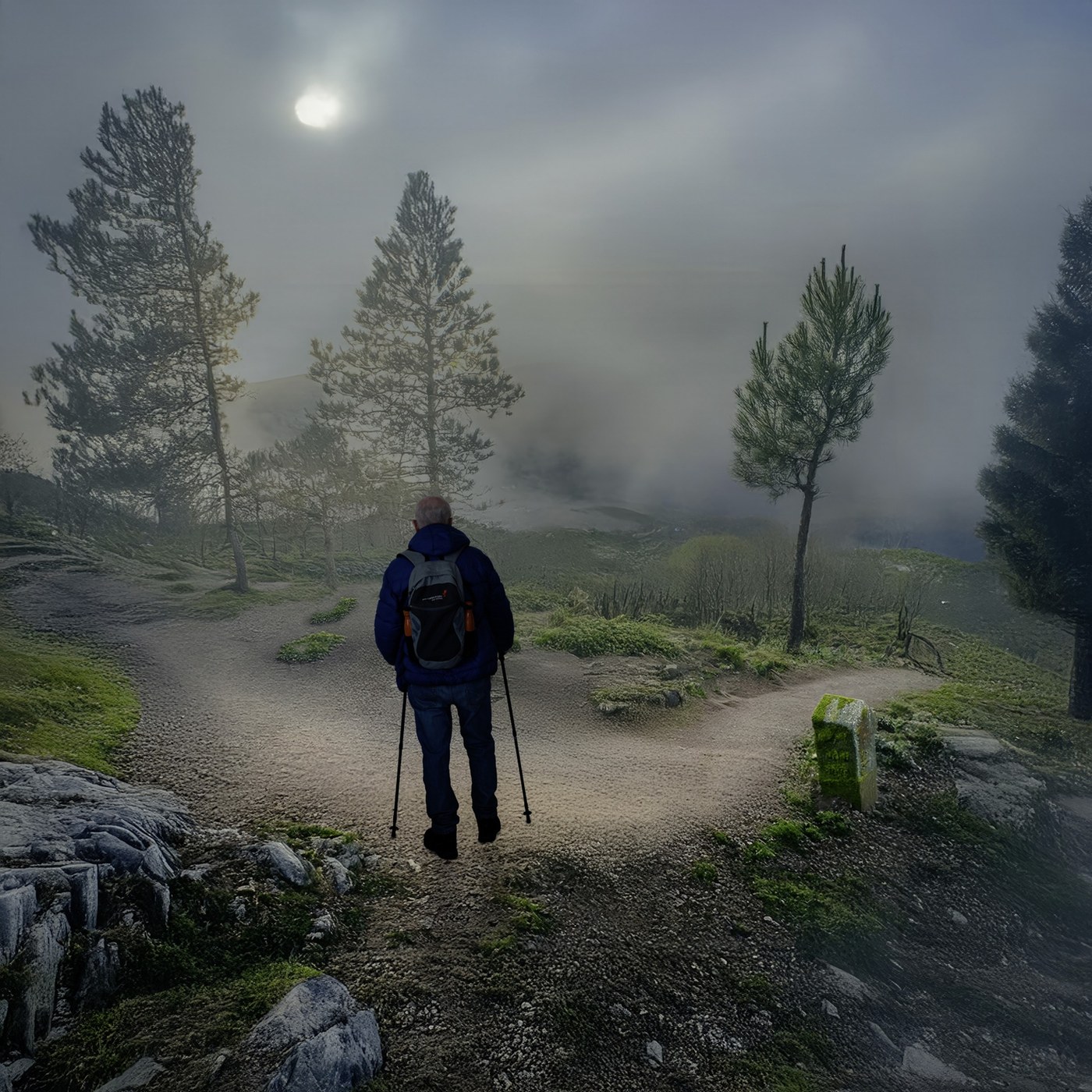
The image "The Road Not Taken" depicts a lone hiker at a forked path within a misty natural landscape. The hiker, dressed in outdoor gear with a backpack and walking poles, stands at the convergence of the paths, seemingly paused in contemplation. Surrounding the figure are tall pine trees, their forms softened by the enveloping fog that dominates the background. The mist obscures much of the distance, creating an atmosphere of mystery and ambiguity. The forked path is framed by patches of greenery and scattered stones, while two moss-covered stone markers stand near the diverging trails, their enigmatic presence enhancing the contemplative mood.
Behind the image
I first encountered Robert Frost’s poem, most likely, in my high school English classes. Years later, I returned to it during my master’s studies in Hebrew and Comparative Literature.
In the poem, a person comes to a fork in the woods. He looks at the two roads, knows he cannot travel both, and chooses one. The other road remains behind, along with the question of where it might have led him.
At my age, I find myself thinking about decisions I have made throughout my life, and about the roads I might have chosen differently. But it is clear to me that there is no real way to return to the same crossroads and choose again. Even if I could return to that place, I would arrive with everything I have experienced since continuing along the road I chose. I would not be the same person who stood there the first time.
This thought reminds me of the saying attributed to the Greek philosopher Heraclitus: you cannot step into the same river twice. The water keeps flowing and changing; and we change too.
My image grew out of this reflection on the roads I chose and those I left behind. I can imagine where they might have led, but I will never be able to know.