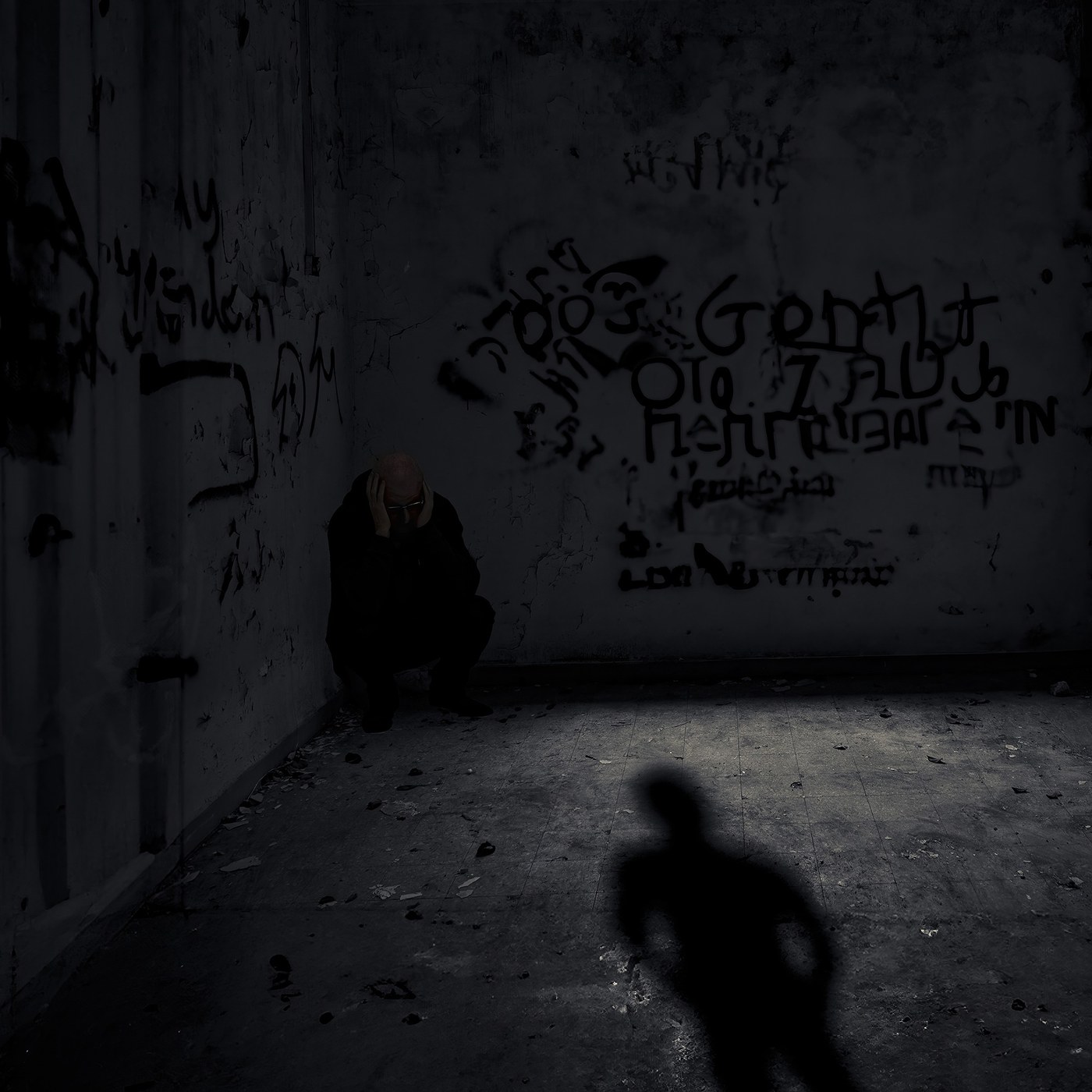
In the image titled "Room 101," the protagonist crouches in the corner of a dark, dilapidated room, echoing the claustrophobic atmosphere described in George Orwell’s 1984. The room is bare, with peeling walls covered in graffiti and patches of decay, evoking a sense of neglect and despair. The protagonist, dressed in dark clothing, appears small and vulnerable, his hands covering his ears as though to block out some unbearable noise or experience. He is positioned in the far corner of the room, isolated and seemingly consumed by fear or anguish.
Behind the image
The first thing I notice in “Room 101” is the distance: the stretch of floor between the man curled up in the corner and the shadow entering the room. Nothing is happening in that space yet, but it is already charged with menace. At any moment, the distance may close. Waiting becomes part of the torment.
The man makes himself as small as possible. His head is bowed, his hands held against it, his clothes almost merging with the darkness. The room dwarfs him. Peeling walls, strange markings and empty space seem to push him to the edge of the world. The corner offers shelter on two sides, but it also marks the point beyond which he cannot retreat.
Facing him is no face, no gaze he can meet, no body whose strength he can measure. There is only a shadow. The unseen jailer commands a greater presence than the person we can see. We do not know what he will do or when he will advance. The image leaves these details outside the frame, and imagination supplies them. Even the light offers no reassurance: it casts the threat across the floor.
The writing on the walls suggests language that has lost its power to connect people. There are marks, perhaps traces of statements or cries, but no sentence to hold on to. Their authors remain unknown. The man is surrounded by human traces, yet utterly alone.
The title connects this isolation to Orwell’s “1984”: a power that knows an individual’s breaking point and turns that knowledge against them. The particular fear need not be shown. Its absence allows each viewer to imagine something different. The question is not simply how much suffering we can endure, but what we might do to make the threat fall elsewhere.
Most disturbing is where the shadow comes from: our side of the image, beyond the fourth wall. We look toward the prisoner from close to the jailer’s position. This does not make every viewer a tormentor, but it unsettles the comfort of being a neutral observer.
I read this image as a political and human warning, not a prediction. It asks what happens when power turns private fear into an instrument of control. And beneath that question lies another: will we recognize the room while there is still time to prevent it from being built?