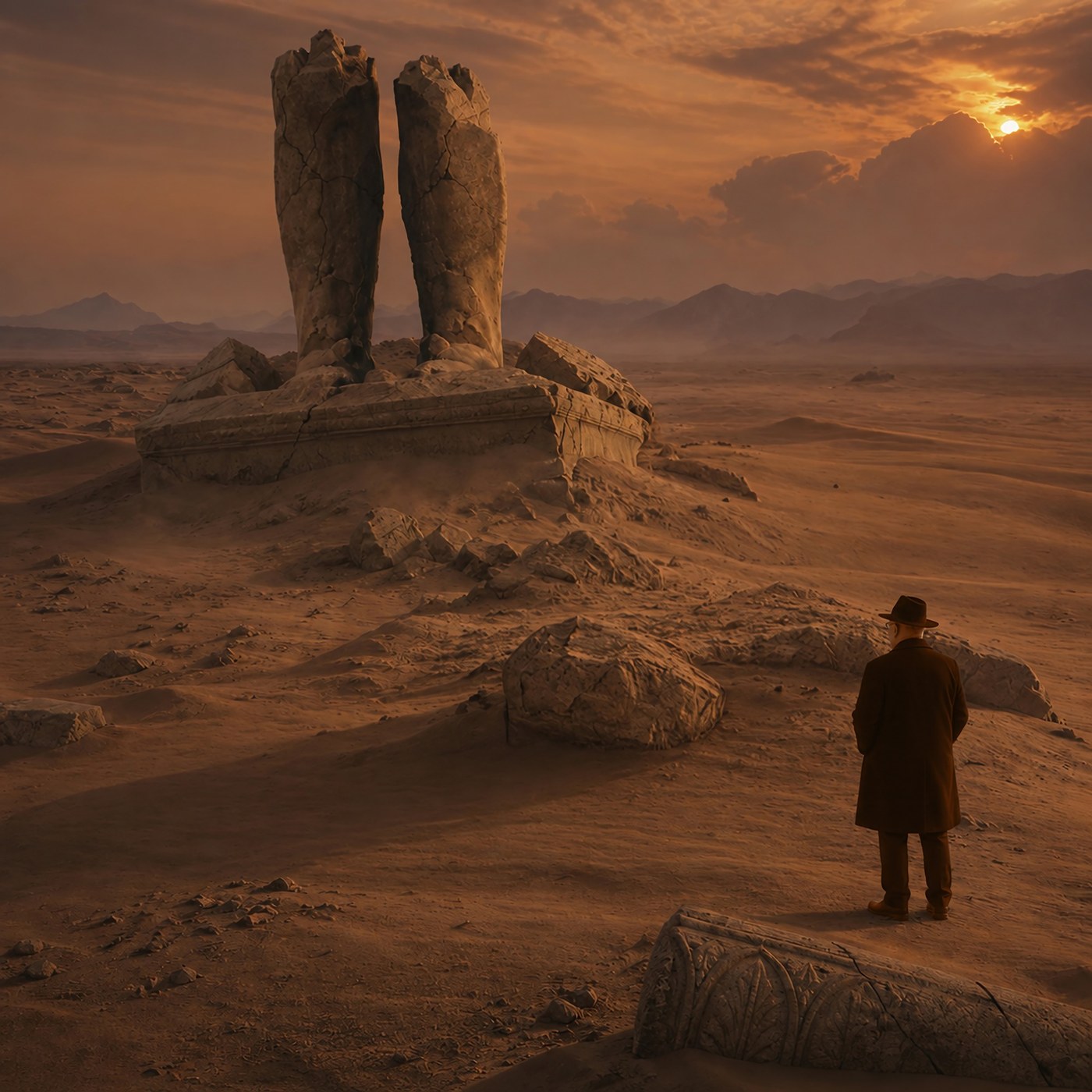
In the image titled "Ozymandias," the scene is set in a vast desert landscape at sunset, bathed in warm, reddish tones. The viewer is immediately reminded of Percy Bysshe Shelley’s poem, as colossal, decayed statues and fragments of stone, resembling his likeness, are scattered across the barren landscape. Two enormous, weathered stone legs stand on a crumbled pedestal in the center of the image, towering over the surrounding ruins. These cracked and broken legs are all that remain of a once grand statue, evoking a sense of lost grandeur and decay.
Behind the image
A Life Before the Ruins
Two immense stone legs stand against a copper-colored sky. The rest of the statue has fallen, its fragments scattered across the desert. At the lower right, a man in a dark coat and hat faces the ruins. The difference in scale is striking: even what remains of the monument towers over him. Yet it is the small, living figure that holds my attention.
The figure is Dov himself. Knowing this changes how I read the image. He has described time as an increasingly important concern as he grows older, and this work belongs to a wider series exploring time and his own place within it. The encounter before us is therefore personal as well as literary. An individual life stands before the wreckage of a claim to permanence.
The title comes from Percy Bysshe Shelley’s poem Ozymandias. Its ruined statue bears the boast of a ruler who calls himself the “King of Kings,” while the emptiness surrounding it exposes the distance between his ambition and what has survived. Dov’s image gives that irony a physical scale. The legs are enormous, but they can no longer support the body they were made to carry.
What interests me most is the meeting of two different measures of time. The ruined monument suggests centuries; the man looking at it brings the scene back to the span of a human life. We can understand historical time in dates and dynasties. Growing older makes time something we experience in ourselves. Here, those two kinds of understanding occupy the same landscape.
The warm light keeps the scene from feeling merely bleak. It catches the cracked stone and stretches across the sand, making the remains beautiful without making them whole. I find that distinction moving. Damage and beauty are visible together.
There is no expression to read on Dov’s turned-away face, and I would not presume to supply one. His presence is enough. It brings an ancient poem into the present and makes its question intimate: how do we live with the knowledge that even what seems most enduring will change?