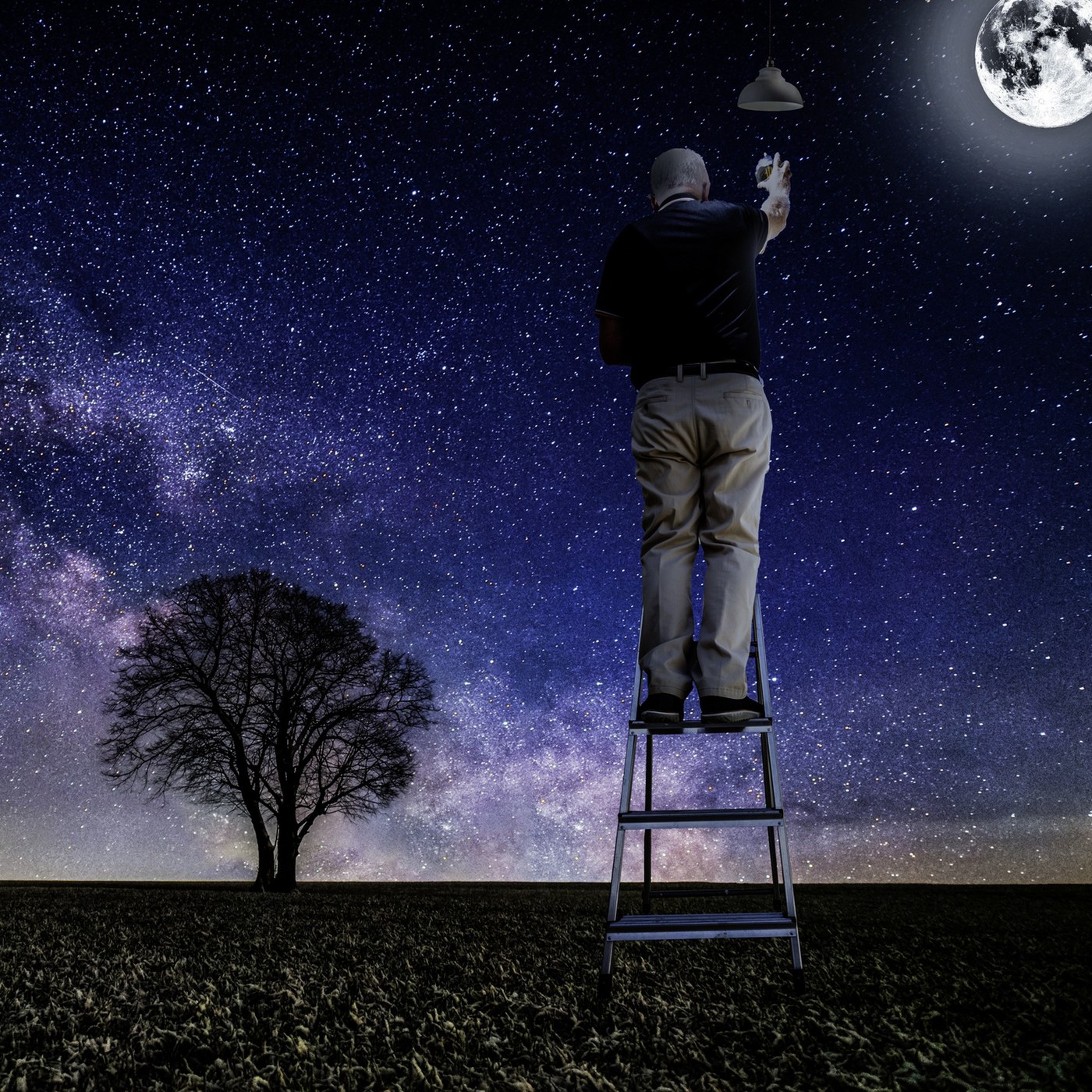
In the image titled "A Malfunction at the End of the Galaxy," the protagonist stands on a ladder, reaching up toward the vast expanse of a starry night sky. His back is turned to the viewer as he stretches his arm toward a hanging lightbulb that dangles above him, parallel to the full moon, as though he is about to change or adjust it. The stars stretch out in a dazzling display, with the Milky Way clearly visible, creating a contrast between the infiniteness of the galaxy and the small, human figure in the foreground. The lone tree silhouetted against the cosmic background adds a sense of solitude and contemplation.
Behind the image
I haven't read the Etgar Keret collection whose title inspired this image. I simply liked the name: A Malfunction at the End of the Galaxy. My love of science fiction made that title especially inviting. I had no idea what the malfunction in the book might be, so I gave myself a different problem to solve: there are so many lights in the sky. What if one of them has gone out?
Perhaps the bulb has burned out. Perhaps something has gone wrong with the circuit. I don't know exactly what needs repairing, but I can put myself on a ladder and try to replace the broken light. That is the game I am playing here. The galaxy supplies the setting, and I turn up to attend to the lighting.
In the image, my back is toward the viewer and my hand reaches up to a suspended light fitting. The ladder, the clothes, and the gesture belong to an ordinary repair job. Around them are the moon and a sky full of stars. I like the awkwardness of bringing those things together. An enormous setting can still contain a small, familiar task.
Making the image belongs to my usual way of working. I put my camera on a tripod, set everything up, and place myself in the awkward positions the image requires. I try to get the perspective right so that the photographed figure will fit with the other elements. An idea can be as improbable as I like, but the parts still have to match when I bring them together.
Then comes the work in Photoshop, where I assemble the image and add what is needed. In my practice, some elements come from repositories and others I create myself; there can also be AI additions. The combination varies from image to image. The point is to build a scene in which I can take part, however unlikely the situation.
Here, the title was enough to start that process. I did not need to discover Keret's explanation before inventing my own. There is a light that may need changing, and there I am, reaching for it. Whether the trouble is really the bulb or the circuit can remain undecided.