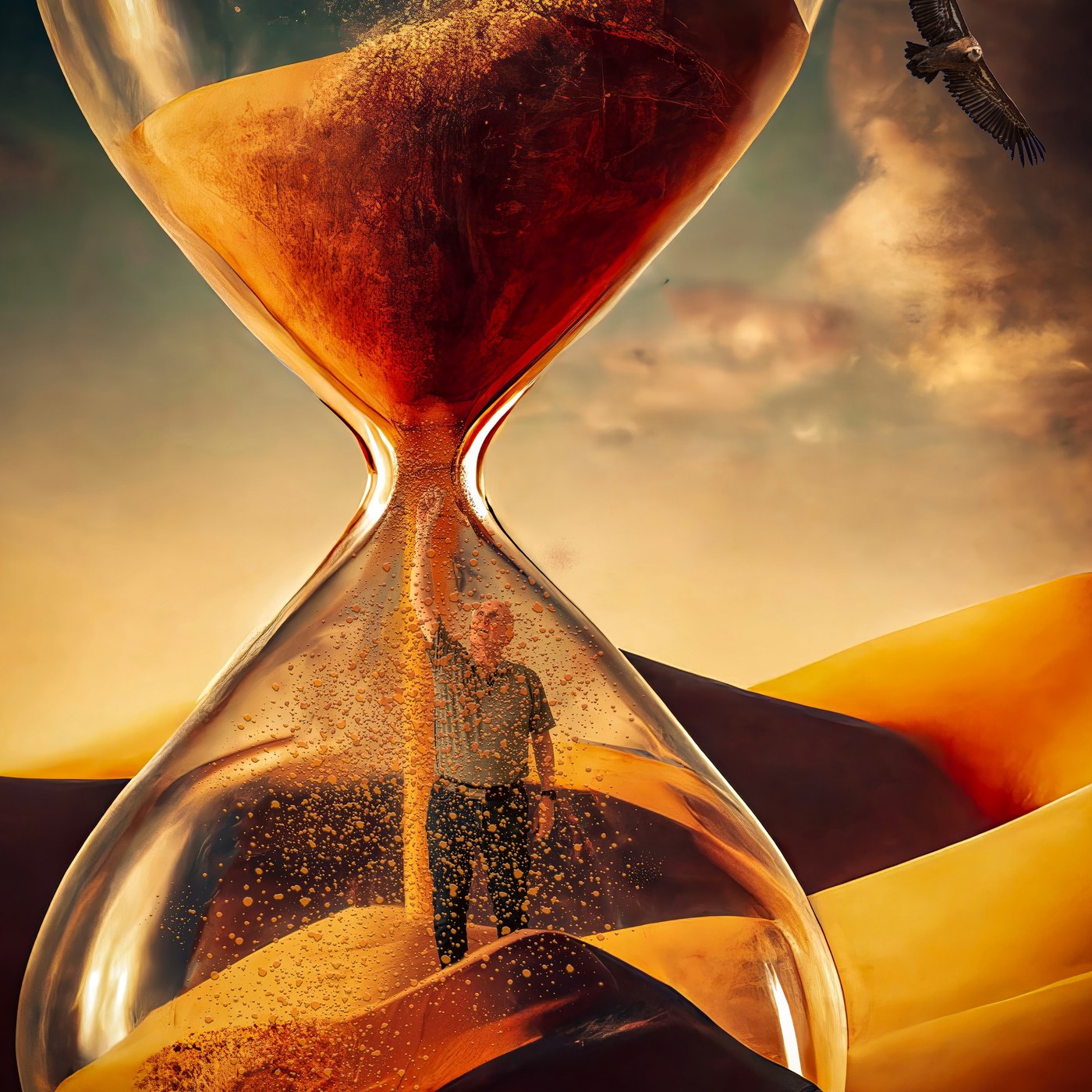
In the image titled "The Hourglass," the protagonist is trapped inside a giant, transparent hourglass, standing in the lower chamber as sand slowly descends from the upper chamber. The setting is a desert landscape, with towering sand dunes and a warm, golden light illuminating the scene, evoking the passage of time. The protagonist raises his arm toward the narrow middle of the hourglass, attempting to hold back the flow of sand that is beginning to envelop him. His expression is calm yet resigned, as though he is aware of the inevitability of time slipping through his fingers.
The Hourglass
Archival pigment print · 2023
1X Gallery — Published
Living the Photo Artistic Life — Issue 95, January 2023
Exhibited — Global Art
Archival prints from $800 · editions of 7, 3 and 1
◆ Signed Certificate of Authenticity in every package
Reading the work
The dominant theme in “The Hourglass” is the passage of time and human mortality. The hourglass is an age-old symbol of time, and in this image, it serves as a poignant metaphor for the limited time each person has. The protagonist’s attempt to hold back the sand reflects a universal human desire to resist or slow down time, though the effort is ultimately futile. The image suggests a contemplation of life’s transience and the inevitability of aging and death. Another theme is the struggle for control in the face of inevitability. The protagonist’s raised arm, as though trying to prevent the sand from falling, speaks to the human impulse to try and control time or delay the inevitable. However, the sand continues to fall, implying that time cannot be controlled or stopped. The scene captures a moment of defiance mixed with acceptance, portraying the inner conflict between fighting against time and acknowledging its power. The presence of the desert landscape and the sand dunes reinforces the idea of vastness and emptiness, echoing the passage of time on a larger, more cosmic scale. The protagonist is dwarfed by the sheer scale of the environment, suggesting that, in the grand scheme of things, human life is small and brief. The desert is also a place of isolation and desolation, which adds a layer of introspection to the image, as though the protagonist is not only facing time but also confronting himself. The bird hovering overhead introduces a darker, more ominous theme: the inevitability of death. The crow or raven, often seen as a symbol of death or transformation, watches over the scene as a reminder that the end is always near, no matter how much one tries to resist. Its presence adds a sense of urgency to the protagonist’s struggle, making the hourglass not just a symbol of time but also a countdown to an eventual, unavoidable conclusion. Finally, the theme of existential reflection is woven throughout the image. The protagonist’s position in the hourglass, his gesture, and the overall atmosphere of the scene invite the viewer to contemplate their own relationship with time, life, and death. The image serves as a visual meditation on the human condition, capturing the tension between our desire to live fully and the inevitable constraints of time.