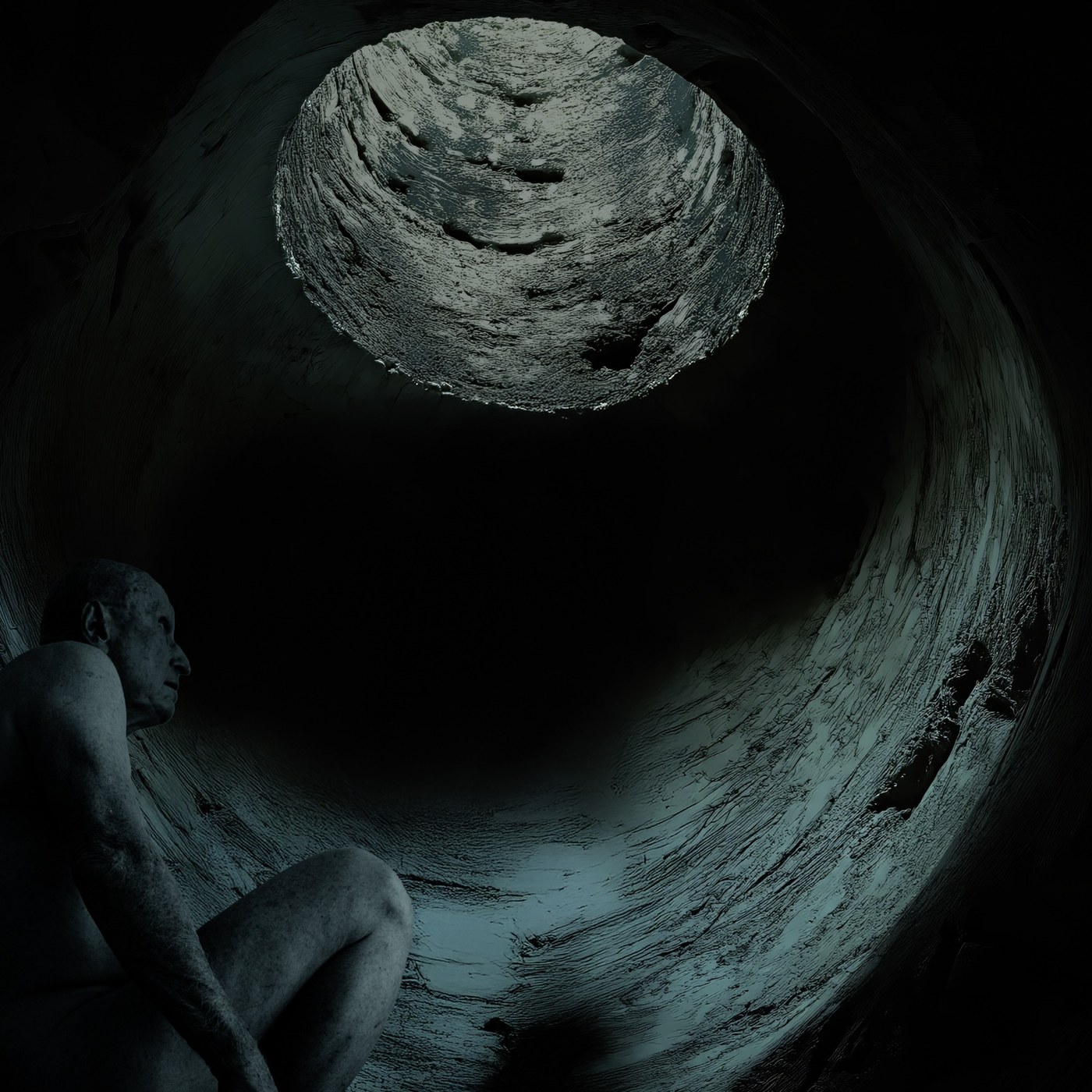
"The Well 1" strongly evokes themes of entrapment, introspection, and existential solitude. The well, a recurring symbol in literature and mythology, often represents the subconscious, a descent into one's inner world, or a state of forced contemplation. In the context of The Wind-Up Bird Chronicle, which inspired this piece, the well serves as a liminal space between reality and the unknown, a place where time dissolves, and the boundaries of self are tested. The protagonist in Murakami’s novel willingly enters the well in search of meaning, much like the figure here, who appears resigned to his descent, stripped of all but his thoughts. His nudity enhances the vulnerability of the moment, suggesting a confrontation with the self in its rawest form. The dimly lit, rough walls of the well reinforce the idea of time’s erosion, while the distant opening above presents an ambiguous contrast—does it offer the hope of escape, or is it merely a reminder of an unreachable world?
Behind the image
Haruki Murakami holds a place of honor among my favorite writers, alongside Homer, Bulgakov, García Márquez and others. I have read all fifteen of his novels, as well as several of his short-story collections. Among the recurring places in his fictional world, the well particularly intrigues me.
In The Wind-Up Bird Chronicle, the protagonist descends into a dry well. In Killing Commendatore, too, there is a deep space beneath the ground, while in Hard-Boiled Wonderland and the End of the World, the narrator travels through the depths of Tokyo with the scientist’s granddaughter. These are not identical places, but in all of them, the descent takes the characters away from the familiar world and leads them to strange encounters and events.
To me, Murakami’s well can be a place of quiet and solitude, where one can step away for a moment from the world above. But it can also be an unsettling place, on the boundary between familiar reality and another world.
In this image, I placed myself at the bottom of the well, trying to feel what Murakami’s characters experience when they descend into it. I cannot say that I succeeded, but at least I tried.
Murakami’s worlds also appear in another image of mine, The Library of the Forgotten Dreams, inspired by the library and the dream reader in The City and Its Uncertain Walls. Like the well, this library allows me, through the image, to enter a world the writer created.