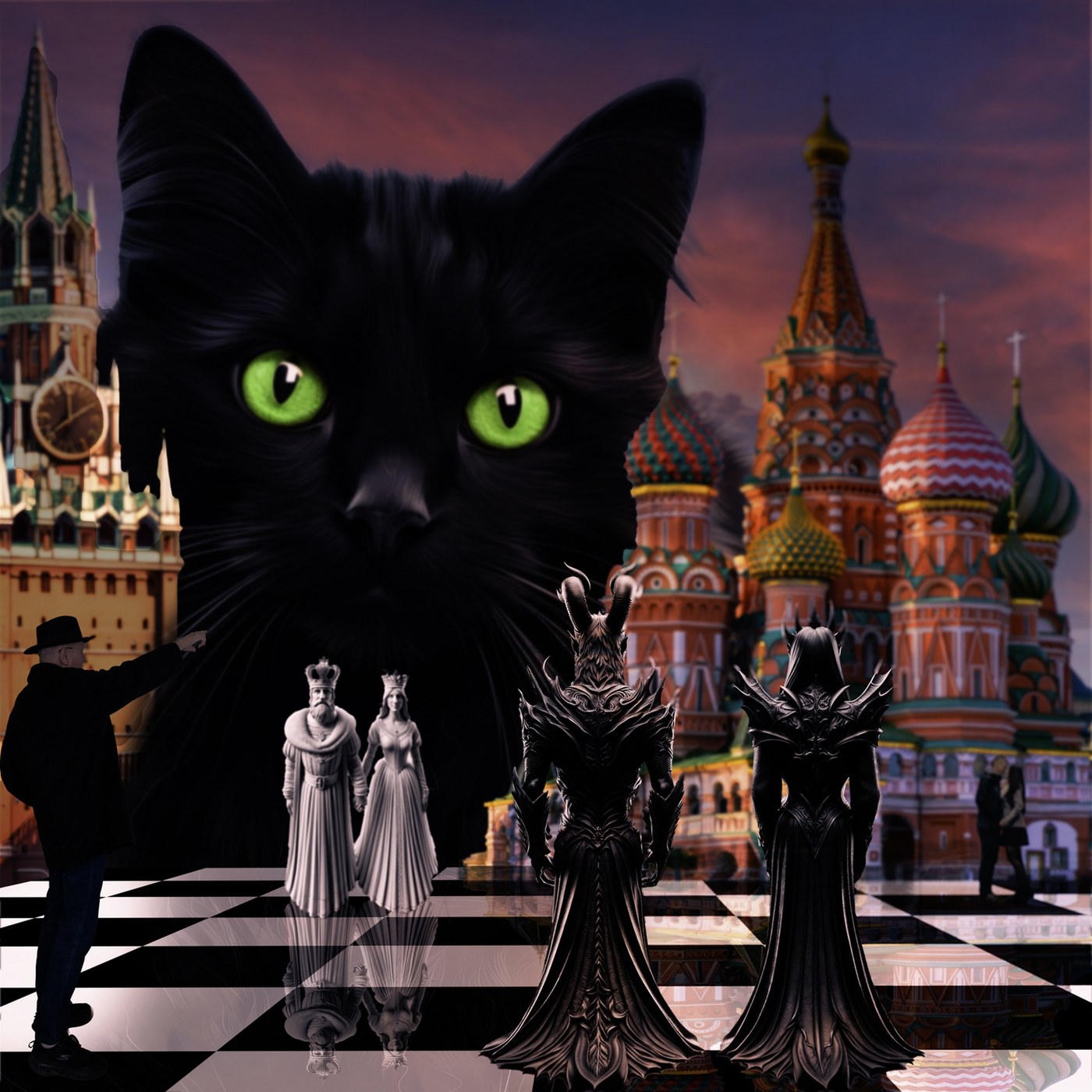
Set on a giant chessboard in Red Square, this surreal image, titled The Master and Margarita" , brings to life characters and symbols from The Master and Margarita. A colossal black cat with piercing green eyes—Behemoth—dominates the scene, facing off against human-sized chess figures: noble white royalty and sinister dark warriors. The artist himself appears at the edge, pointing toward the feline as if invoking it into this grand metaphysical contest. Behind them, Moscow’s iconic domes glow under a dramatic twilight sky, blending reality and fantasy in striking harmony.
Behind the image
The Cat Above the Chessboard
The first thing I notice in Dov’s The Master and Margarita is the enormous black cat. Its green eyes look directly out of the image, while Moscow’s towers and colored domes rise behind it. The scale is absurd, almost comic, yet there is something unsettling about seeing a city dwarfed by a creature that seems entirely at ease.
This is Behemoth, the mischievous cat in the devil’s entourage. He brings something essential to the scene: the possibility that laughter can unsettle authority as effectively as force. His immense presence makes the city’s solemn architecture look almost like a theatrical backdrop. I read his gaze as an invitation to notice how ridiculous supposedly unquestionable power can become.
That mixture of humor and unease belongs to the world of Mikhail Bulgakov’s novel. The devil arrives in Soviet Moscow, and the disruption he brings exposes corruption and human weakness. Authority may look imposing until something happens that it cannot explain or control.
Dov places himself at the left of the image, pointing toward the Kremlin. He directs our attention toward a center of political power, while the giant cat makes that power appear less secure. The city remains magnificent, but its grandeur can no longer guarantee its authority.
Across the foreground stretches a marble chessboard. Its black and white squares reflect the figures above them. The white pieces face a black king and queen whose elaborate armor and horned silhouettes dominate the near edge of the board. Their size and ornament make them formidable opponents.
Dov describes the white pieces as playing and, hopefully, winning. I find that hope important. The image does not give us a completed victory. It leaves the struggle in progress. The white pieces are still standing, still engaged, despite the intimidating presence before them. This is the artist’s hope given visual form, rather than a simple moral key to Bulgakov’s complicated novel.
Above the contest, Behemoth remains impossible to ignore. Is he watching, interfering, or enjoying a game whose rules escape everyone else? The image leaves that question open. His comic presence prevents the scene from becoming entirely solemn; his enormous scale prevents it from becoming merely amusing.
Looking at the board beneath those watchful green eyes, I find myself waiting for the next move, and hoping with Dov that power will not have the final word.