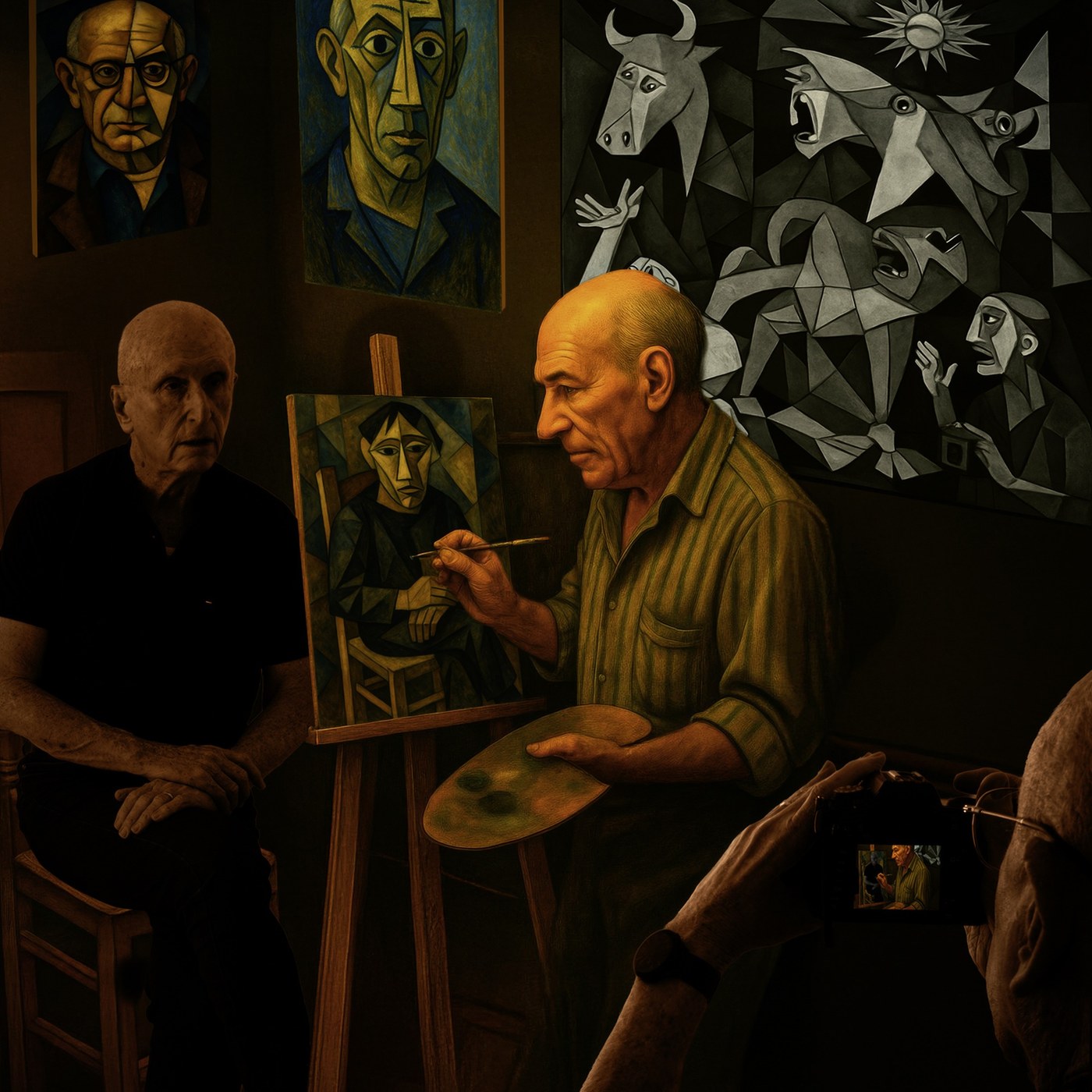
"The Cubist Time Traveler" is set in Pablo Picasso’s sunlit studio, this image captures an impossible encounter: a modern-day man—clearly out of place—sits as the master paints his Cubist portrait. The same man appears again in the corner, camera in hand, documenting the moment as it unfolds. Yet the camera’s viewfinder betrays a paradox—the image displayed does not reflect the real scene. Instead, it shows a distorted version of the portrait-in-progress, misaligned with the physical reality it observes. This layering of presence, perception, and artistic interpretation blurs the boundaries between subject, observer, and illusion.
Behind the image
In Leonardo’s studio, I photographed the model. In Picasso’s studio, I got the job myself. I sat across from him while he painted me, and any resemblance between the man on the canvas and me is purely coincidental. At least he let me keep my black shirt.
There are Cubist portraits on the studio wall, along with a version of Guernica I made with the help of AI. But I put the joke in the smallest part of the picture: the camera screen. Look closer and there’s Picasso, brush in hand, at the same easel. Only now, instead of the angular portrait in the larger picture, the canvas on the screen shows the man in the black shirt again, just as he looks sitting across from Picasso.
I’m sitting for Picasso and, at the same time, I’m standing there with my camera, photographing him painting me. My invisible photographer, of course, is taking a picture of both of me. They say the camera never lies. Mine even corrects Picasso.