In a dimly lit, tunnel-like corridor textured with rough, earthen walls, three figures walk away from the viewer toward a distant light. At the center is an elderly, bald man, shirtless, his hands bound behind his back, escorted by two men dressed in dark, simple garments. Their posture suggests firm control rather than overt violence, each holding one of his arms as they guide him forward. Along the lower edge of the wall, a row of seated, sculptural human forms appears embedded into the ground, their heads bowed or fixed forward, evoking silent witnesses or remnants of past lives. On the opposite wall, dramatically illuminated by a warm, flickering torchlight, a sharply defined shadow of a walking man stretches forward—free, upright, and unbound—contrasting starkly with the restrained figure in reality. The atmosphere is dense, almost subterranean, with light and darkness carefully orchestrated to create a sense of passage, confinement, and metaphysical tension.
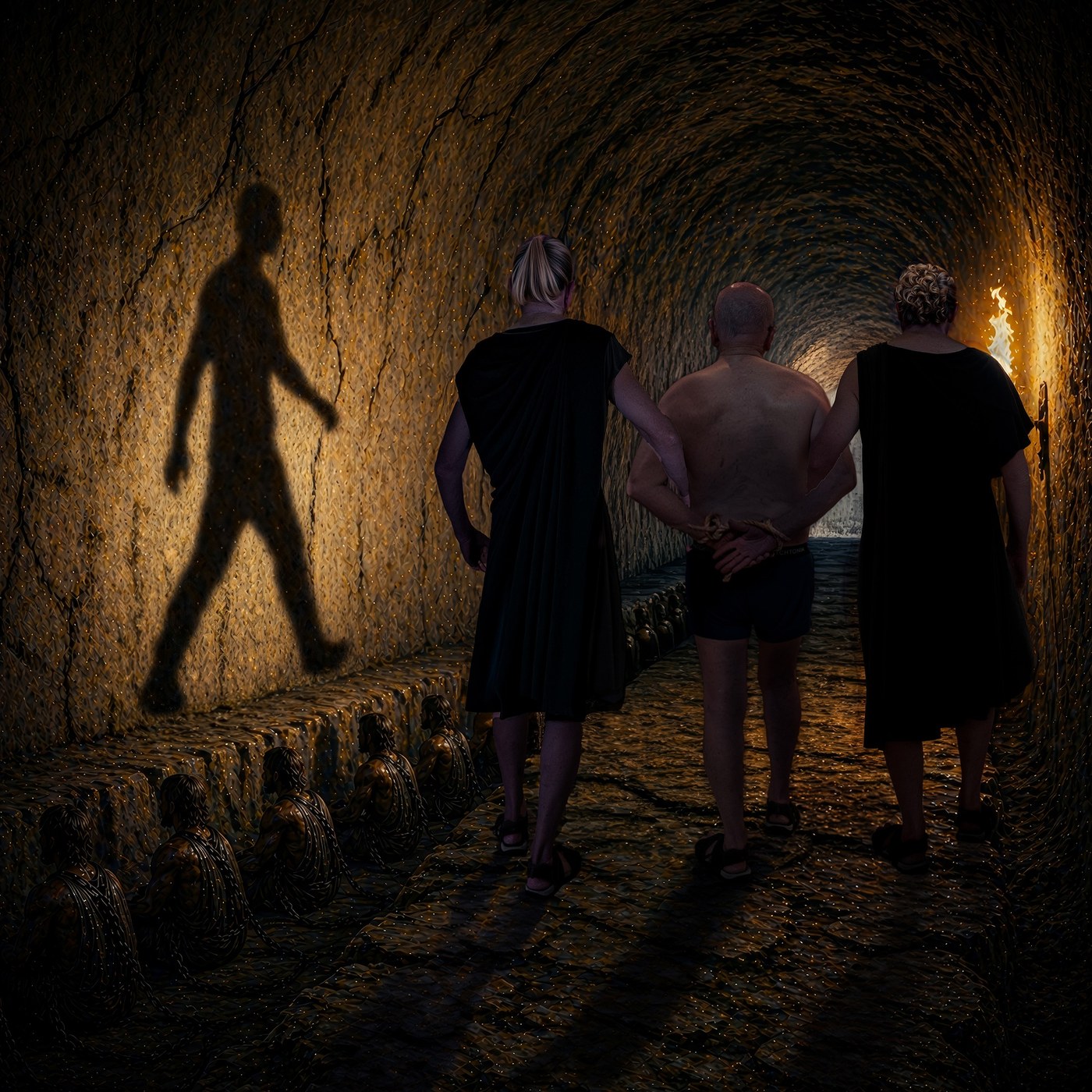
A Free Man
Archival pigment print · 2026
after Plato, Allegory of the Cave, Republic, Book VII, c. 380 BCE
1X Gallery — Published
Archival prints from $800 · editions of 7, 3 and 1
◆ Signed Certificate of Authenticity in every package
Reading the work
The image operates as a powerful meditation on the paradox of freedom and imprisonment—an inversion of Plato’s cave allegory, where the shadow becomes the liberated self while the physical body is constrained. The bound protagonist, escorted through a tunnel of history or memory, suggests the human condition as one of external limitation—social, political, or existential—while the shadow embodies an inner autonomy that cannot be captured. The seated figures embedded in the ground reinforce a sense of collective entrapment or inherited passivity, as though generations have accepted illusion or confinement without resistance. Yet the shadow’s independent stride introduces a subtle rebellion: the idea that freedom is not always a physical state but a psychological or philosophical one. The duality between body and shadow, control and autonomy, presence and projection, aligns deeply with his ongoing exploration of identity and internal conflict. Here, the self is split—not into reflection, but into condition versus essence—raising the unsettling possibility that true freedom may exist only as an intangible extension of the self.