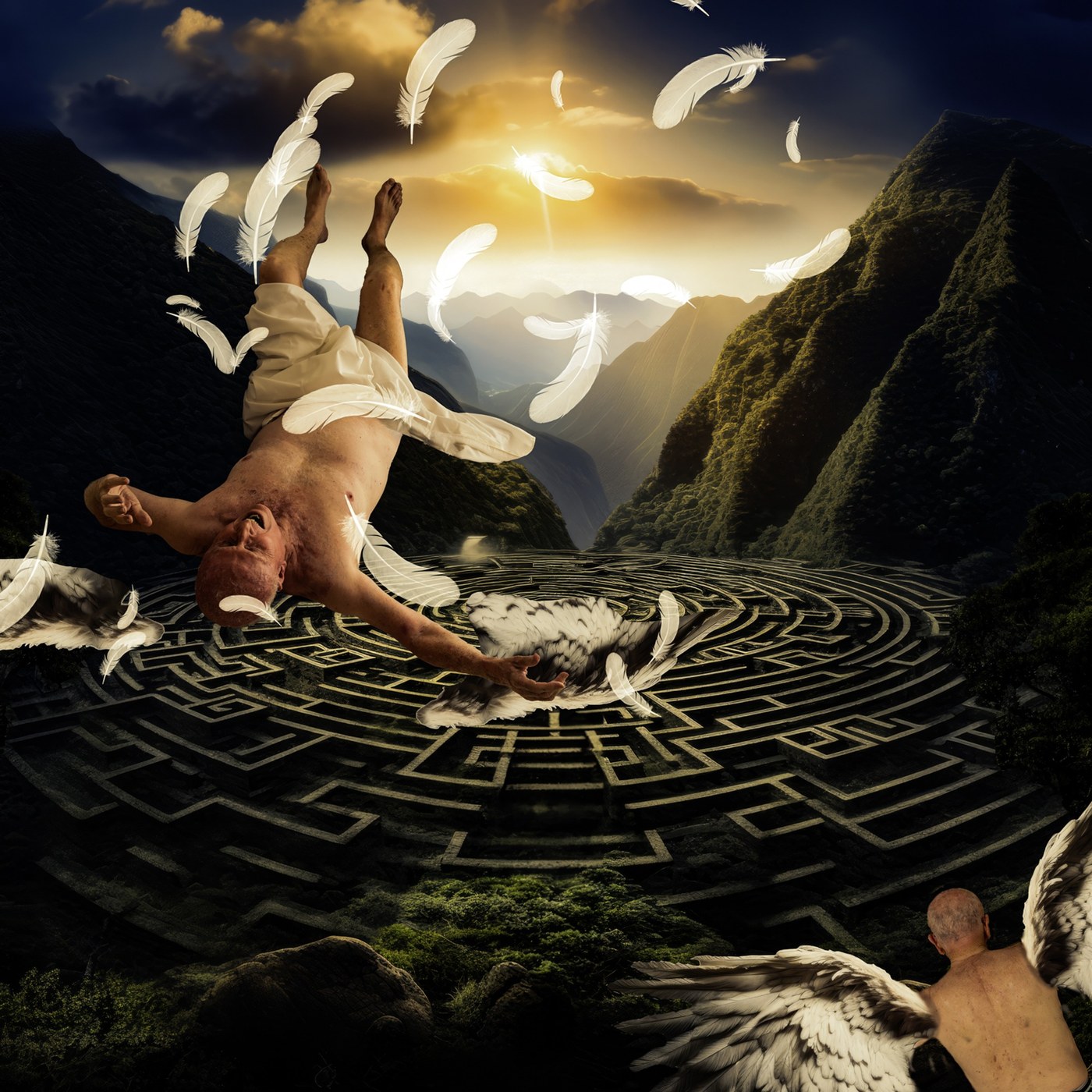
The image titled The Escape from King Minos' Labyrinth is an intricate reimagining of the myth of Icarus and Daedalus. the artist appears in the place of Icarus, depicted in mid-fall, surrounded by floating white feathers, symbolizing the disintegration of his constructed wings. Beneath the artist, a complex labyrinth lies nestled among towering mountains, evoking the mythological labyrinth of King Minos. The sunlight breaking through the clouds suggests a moment of both escape and downfall. The dramatic landscape, with its grand scale and dark tones, contrasts with the lightness of the feathers, emphasizing the tragic nature of this mythological scene.
The Escape from King Minos’s Labyrinth
Archival pigment print · 2023
after Greek mythology, the Minotaur and the Labyrinth
1X Gallery — Published
Living the Photo Artistic Life — Issue 111, May 2024
Archival prints from $800 · editions of 7, 3 and 1
◆ Signed Certificate of Authenticity in every package
Reading the work
The most evident theme here is the reinterpretation of classical mythology, specifically the Greek myth of Icarus and Daedalus. The image captures the timeless cautionary tale of human ambition and hubris. The act of flying too close to the sun, only to fall, resonates with the broader theme of reaching beyond one’s limitations and facing the inevitable consequences. In this case, it is not merely a retelling but a personal embedding within the myth, suggesting a deeper, introspective exploration of ambition, self-doubt, and failure. There is also a theme of escape versus entrapment. The labyrinth itself represents complexity, confusion, and the feeling of being trapped, while the wings symbolize hope and the desire for freedom. The juxtaposition of these symbols reflects an internal struggle between wanting to break free and the fear of falling or failing in the attempt. The setting and the descent connect with a broader existential theme: the fragility of life and the consequences of choices made in pursuit of freedom or ambition. Additionally, the image could reflect personal themes of aging and mortality, as seen in the fragility of the wings and the inevitability of falling, which might symbolize the passage of time and the limitations of human existence. Finally, the image embodies visual storytelling, with the mythological reference serving as a framework for a broader exploration of human desires, risks, and consequences.