In the image titled "A Portrait at the Exhibition," the protagonist, dressed in dark, casual clothing, appears to be stepping out of or emerging from a portrait frame. The frame, which is attached to a wall, seems to have been partially lifted by the protagonist himself, as though he is breaking free from its confines. His upper body is almost fully outside the frame, while his lower half remains partially inside, creating a surreal, in-between state where the subject exists both within the two-dimensional confines of the portrait and in the three-dimensional world.
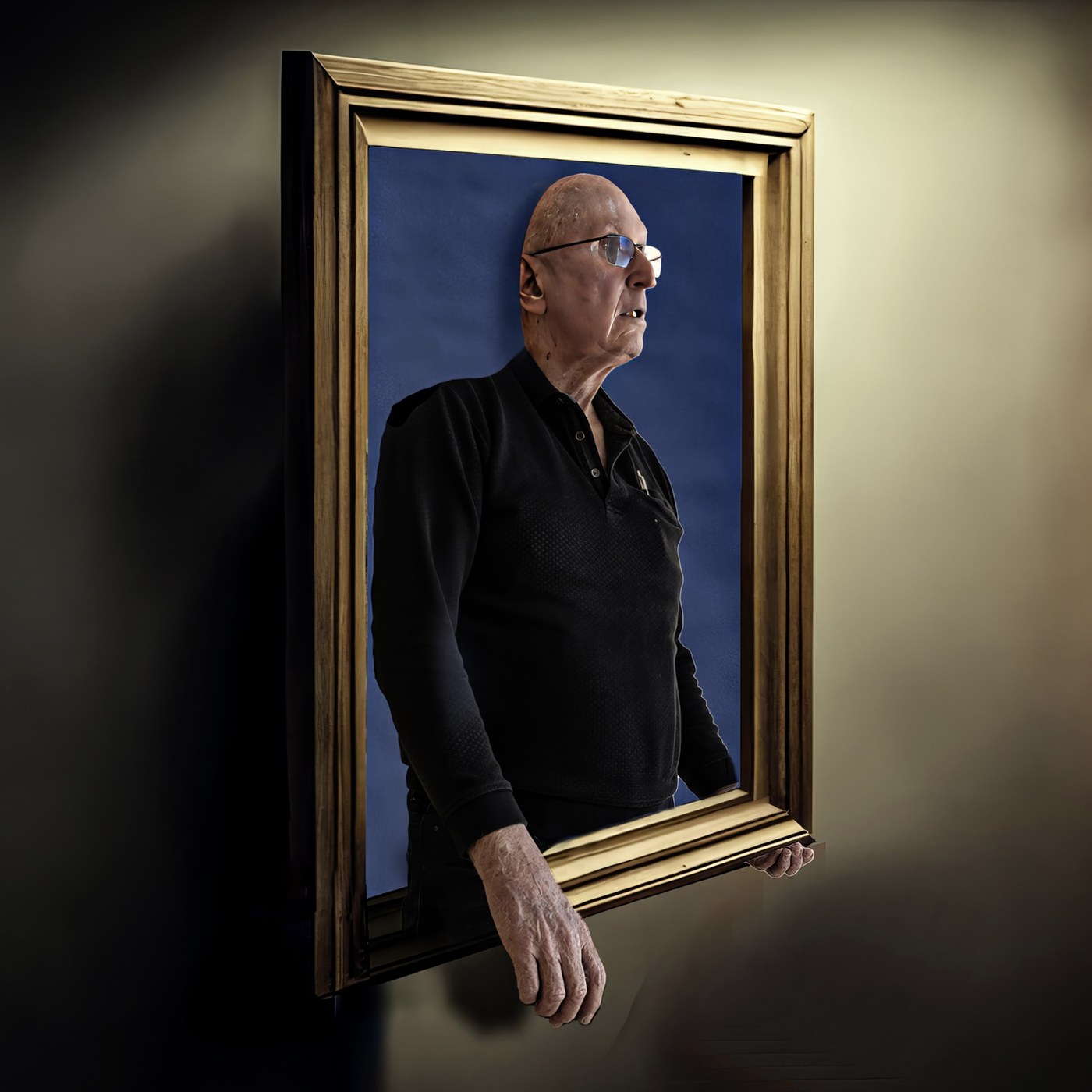
A Portrait at the Exhibition
Archival pigment print · 2023
1X Gallery — Published
Archival prints from $800 · editions of 7, 3 and 1
◆ Signed Certificate of Authenticity in every package
Reading the work
The dominant theme in “A Portrait at the Exhibition” is breaking free from constraints. The act of the protagonist emerging from the frame symbolizes a release from the limitations imposed by the portrait. It suggests a desire to move beyond the static, predefined role of being merely a subject to become an active participant in the world. This could be interpreted as a metaphor for self-realization or the process of stepping out of societal expectations or personal limitations to become a fuller, more authentic version of oneself. Another theme is the relationship between art and life. By having the protagonist exist simultaneously within and outside of the frame, the image explores the boundary between the two. It blurs the distinction between art as a representation of life and life itself, questioning the traditional roles of subject and observer. The protagonist’s emergence suggests that these roles are not fixed and that individuals can transcend the confines of how they are portrayed or perceived. The theme of self-examination is also present, as the protagonist’s contemplative gaze hints at introspection. His calm demeanor contrasts with the dramatic act of stepping out of the frame, suggesting that the process of breaking free is not one of frantic rebellion but rather a deliberate and thoughtful decision. The image may be suggesting that personal growth and liberation require deep reflection and intentional action. Finally, the theme of identity is underscored by the protagonist’s partial emergence from the portrait. The image raises questions about how identity is constructed and whether it is defined by external perceptions (the portrait) or by one’s own actions (the act of stepping out). The frame, which traditionally confines and defines a subject, becomes a tool for the protagonist’s transformation, suggesting that even the boundaries placed upon us can become part of the process of self-realization.