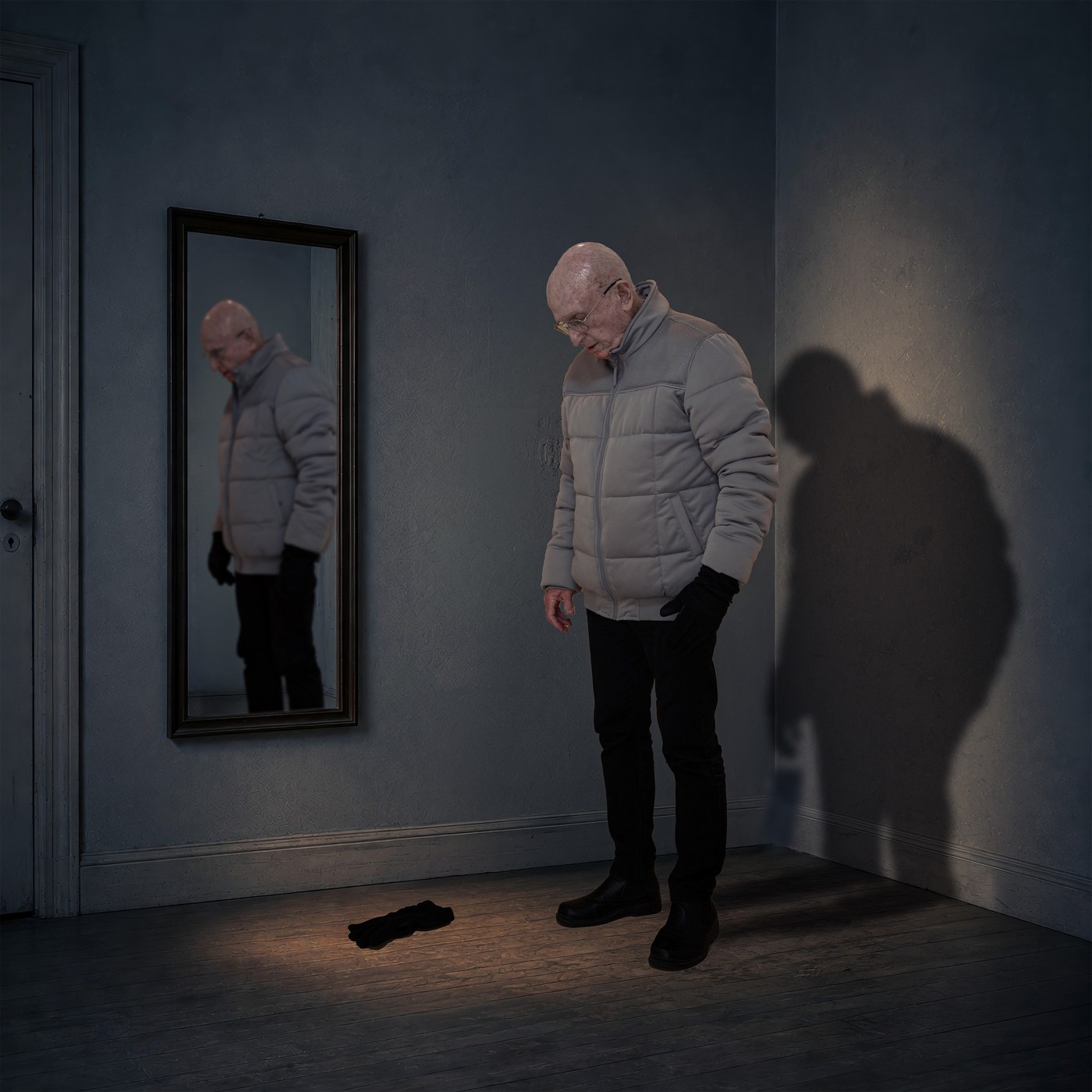
In a dimly lit, nearly empty room, an elderly man stands motionless, staring at a single black glove resting on the wooden floor before him. His bowed posture suggests quiet contemplation rather than surprise, as though the ordinary object has suddenly acquired unexpected meaning. A mirror mounted on the wall reflects his figure from another angle, while his shadow stretches across the adjacent wall. On closer inspection, however, the shadow reveals an impossible detail: although the glove has already reached the floor in reality, its shadow is still falling from the shadow's hand. This subtle temporal inconsistency transforms the otherwise ordinary scene into a quiet surreal paradox, where light, reflection, and shadow no longer obey the same moment in time.
The Glove
Archival pigment print · 2024
1X Gallery — Published
Exhibited — Fox Yard Exhibition
Archival prints from $800 · editions of 7, 3 and 1
◆ Signed Certificate of Authenticity in every package
Reading the work
This image explores the relationship between memory, perception, and the nonlinearity of psychological time. The fallen glove serves as a catalyst for reflection, symbolizing a moment that appears complete in the physical world yet remains unfinished in the inner world. The shadow, existing a fraction of a moment behind reality, suggests that emotional experience often lags behind objective events—we frequently continue to process, release, or mourn something long after it has already occurred. Together with the mirror, which introduces a second representation of the self, the image presents three parallel realities: the physical self, the reflected self, and the shadow self, each inhabiting a different temporal and psychological dimension. Rather than illustrating a supernatural event, the work offers a visual metaphor for human consciousness itself, where memory, awareness, and acceptance rarely arrive simultaneously. The delayed fall of the shadow-glove becomes a powerful symbol of those moments in life when the mind has not yet caught up with reality, revealing that our inner world often moves according to its own measure of time.